Safebox and the digital go-bag
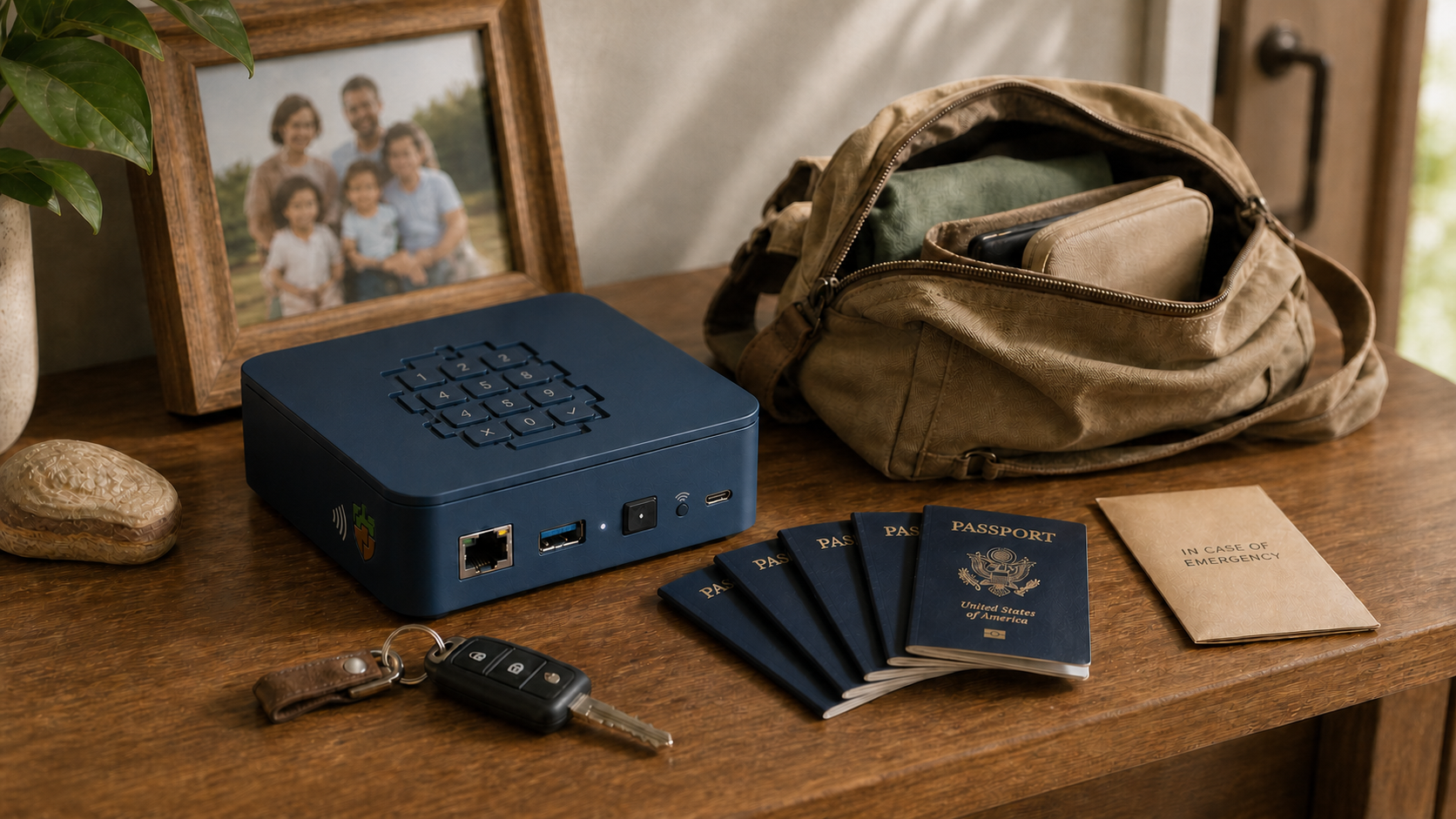
An illustrative product concept: Safebox alongside the final essentials a family might gather before leaving home. The concept includes a physical keypad, Safebox Key tap point, and deliberately activated local Wi-Fi. Final hardware and enclosure design may differ.
Emergency funds and critical records, kept ready
Safebox is a digital go-bag: a deliberately compact collection of the funds and records that a person, family, or community cannot afford to lose when ordinary systems become unavailable.
Safebox is the product people use. Acorn is the protocol-first component inside it, providing portable key authority, private records, funds logic, relay-backed availability, and recovery across compatible environments.
It is not intended to be a generalized storage device, a replacement for a cloud drive, or an archive of everything a person has ever created. Its purpose is narrower and more consequential:
Safeguard the resources that must remain recoverable and usable during disruption.
A Safebox might contain:
- emergency funds;
- birth certificates and civil records;
- passport and travel-document copies;
- health records, prescriptions, and care instructions;
- property, insurance, and legal records;
- emergency contacts and recovery instructions;
- community-issued records and attestations; and
- evidence needed to establish the origin, integrity, status, or control of an important record.
The category is defined by importance rather than volume. Safebox is designed to hold a small number of high-value resources well.
A household safekeeping appliance
The long-term product direction is straightforward: a Safebox appliance that could have a place in every home, much as a physical safe, emergency kit, or fire-resistant document box does today. It would safeguard three bounded classes of resources:
- Master keys — recovery and authority material needed to regain control of an Acorn and the resources it protects;
- Emergency funds — a deliberately limited reserve kept available for disruption and recovery; and
- Critical records — the small set of documents and evidence that must survive device, provider, network, and building loss.
“Master keys” does not mean that Safebox should become a general password manager or collect every credential a household uses. It means the root cryptographic material whose loss would prevent recovery: Acorn key material, the record protection key (RPK) when that profile is used, and the recovery context needed to locate and reconstruct the corresponding encrypted state.
The appliance is one deployment form, not the boundary of the product. Acorn is being hardened first as an installable protocol component that can run through the command line, a minimal web application, a hosted worker, a FreeBSD jail, or eventually dedicated hardware. This keeps the appliance replaceable: the box provides a convenient local home and execution environment, while recovery material and replicated encrypted state preserve continuity beyond the box.
The aim is not to put another indispensable platform in every home. It is to make dependable household safekeeping practical without making any one device, application, relay, mint, or service provider irreplaceable.
Community mesh payment system
Some people keep earthquake money: a modest reserve for transportation, temporary accommodation, food, medicine, communication, and other immediate needs when an emergency interrupts normal services. That is a useful starting point, but the broader need is not merely to preserve one household's reserve. A disrupted community may also need a way to continue exchanging value when ordinary payment terminals, banks, mobile networks, Lightning routes, or internet services are unavailable.
Safebox generalizes the earthquake-money idea into a community mesh payment system. An Acorn can hold a deliberately limited reserve of ecash, while a local relay running in the Safebox appliance keeps the wallet's signed state available without an internet connection. Nearby Safeboxes and participating devices can provide local access and carry payment messages across a direct, community-operated mesh.
One Safebox can preserve emergency funds. A mesh of Safeboxes can help a community continue exchanging value during disruption.
A possible offline flow is:
payer's Acorn
  -> selects ecash already held by the wallet
  -> transfers the bearer proofs to the recipient
  -> publishes or carries the encrypted transfer through a local relay or mesh
recipient's Acorn
  -> receives and safeguards the provisional ecash
  -> checks and refreshes it with the issuing mint when connectivity returns
This is closer to passing cash locally than to maintaining an always-online bank account. The local appliance provides access to the Acorn and its stored state; the mesh provides transport between participants; and the mint remains the final authority on whether its ecash proofs are spendable.
That distinction matters. While fully offline, the recipient cannot ask the issuing mint whether a proof has already been spent or immediately refresh it into newly issued proofs. An offline transfer must therefore be presented as provisional, not final settlement. When a participant, bridge device, or community node regains connectivity, the recipient Acorn can reconcile the transfer against the mint by checking and refreshing the received proofs and then recording the confirmed result in its normal wallet state.
Community policy can bound the provisional risk through small transaction limits, known counterparties, local recognition, short offline periods, and clear confirmation status. Safebox should never disguise an unverified offline receipt as mint-confirmed funds.
The community mesh does not replace a mint, create a new consensus network, or promise that every offline proof will settle. It provides a continuity layer: local access to funds already held, direct or store-and-forward transfer, and an orderly path back to mint-confirmed state when wider infrastructure is restored.
A Safebox appliance with an NFC reader and PIN pad could also double as a small payment terminal. In connected mode it could present or acquire a payment request and complete the normal online payment flow. In local or mesh mode it could exchange an ecash transfer directly with another Safebox or participating device and preserve the pending transfer until mint access returns. This gives the same appliance a practical community role: it can be a safe during ordinary life and a local point of exchange during disruption.
The point is not limited to earthquakes. The same preparation matters during wildfires, floods, storms, displacement, prolonged outages, infrastructure failure, politically turbulent conditions, or the sudden loss of a trusted service. Safebox combines the emergency reserve with the critical records a person or community may need during and after the disruption.
A local home with independent continuity
One likely product form is a Safebox appliance with a local relay and an Acorn execution environment. The appliance gives critical encrypted state a home that remains close to the person, household, institution, or community using it. Safebox may also be delivered through a trusted web provider or another compatible application without changing Acorn's underlying protocol role.
That local home is not the only copy:
local Safebox appliance
├── Acorn component, keys, and execution
├── local relay
├── emergency funds
└── critical encrypted records
         │
         ├── encrypted replica on another household appliance
         ├── encrypted replica on community infrastructure
         └── encrypted replica with selected service providers
Replication provides continuity across device loss, local infrastructure failure, displacement, wildfire, flood, earthquake, service interruption, or institutional failure. The independent hosts provide availability without receiving normal plaintext access to the records they hold.
This is closer to a network of reciprocal safes than a shared folder. Participants help preserve one another's encrypted resources while each Safebox, through its Acorn component, retains its own keys and authority.
A physical ceremony for local access
A Safebox appliance could combine a small numeric keypad, an NFC reader, and a physical control for local Wi-Fi. Together they provide an access ceremony that is understandable without turning the appliance into a general-purpose computer.
The NFC credential—provisionally called a Safebox Key—should be a secure smart card or secure-element token rather than an ordinary writable NFC tag. The user taps the key and enters a PIN on the appliance keypad:
physical Wi-Fi press -> short-lived local pairing network
Safebox Key tap      -> possession of the registered secure credential
PIN entry            -> knowledge verified with retry limits
approved session     -> access to the attached or recovered Safebox
For an existing Safebox, successful presentation can authorize a local session against the Acorn already present. For a fresh Safebox, the key can provide or unlock the bootstrap coordinates and recovery package needed to find the encrypted relay state, reconstruct the Acorn authority, and retrieve its funds and records.
The Safebox Key proves what the user has. The PIN proves what the user knows. The appliance restores what the user controls.
Deliberately activated local Wi-Fi
The appliance may advertise its own Wi-Fi SSID only after someone physically presses a recessed Wi-Fi control. This creates a short, intentional pairing window for a nearby phone, tablet, or computer. The SSID is a convenience and presence signal; it is not authentication and should never expose the wallet, records, relay administration, or the surrounding network by itself.
Before the Safebox Key and PIN are accepted, the temporary network should provide only a narrowly isolated pairing surface. A safe sequence is:
- The user physically enables the Wi-Fi pairing window.
- Safebox advertises a device-specific SSID for a limited period.
- A nearby client may connect only to a restricted local pairing service.
- The user taps the registered Safebox Key and enters the PIN on the appliance.
- The trusted input controller approves and binds that specific local session.
- Safebox attaches to the existing Acorn or performs the authorized recovery.
- The pairing window closes automatically after success, cancellation, or timeout.
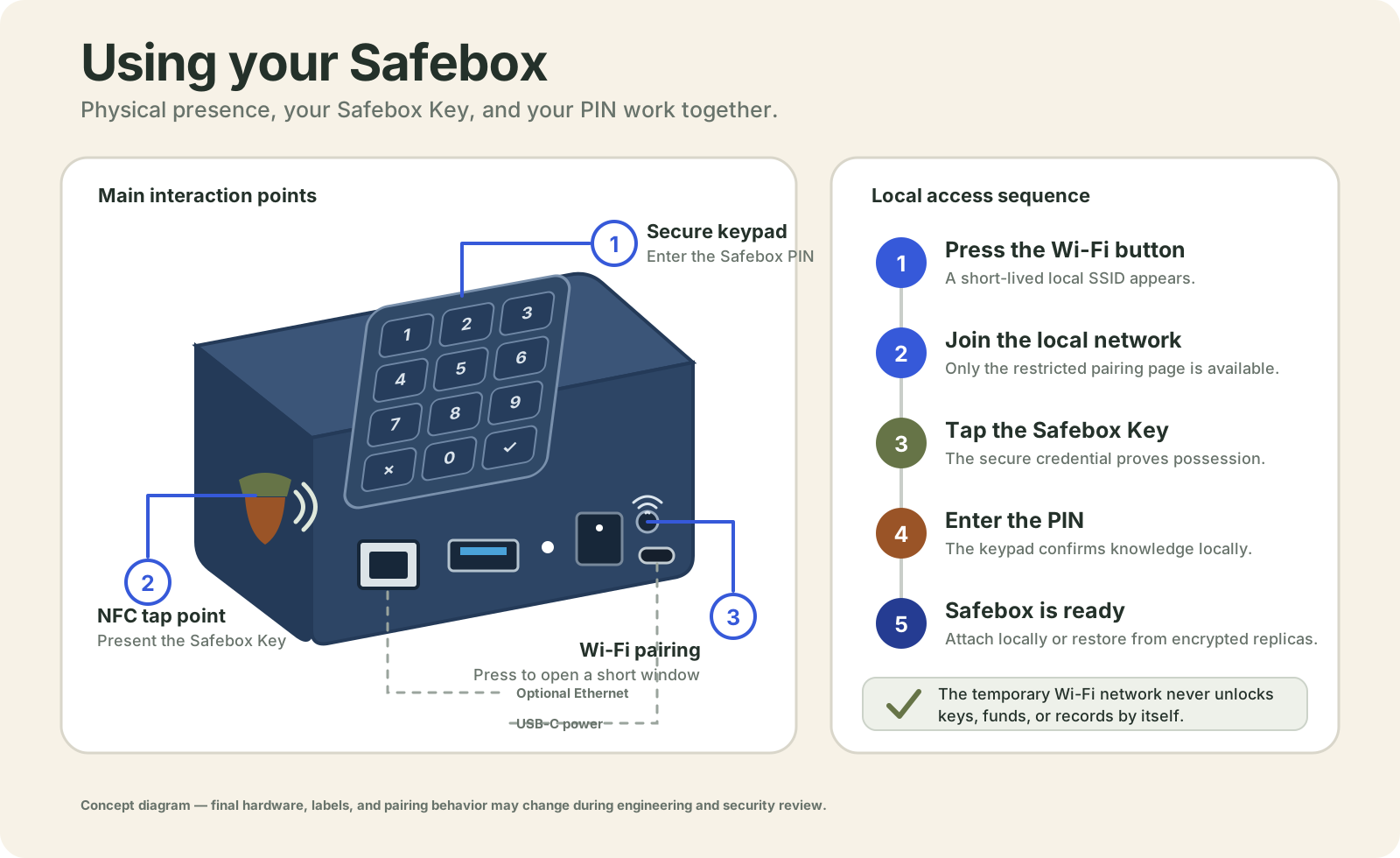
The local interface is deliberately small: physical intent opens the pairing window, while the Safebox Key and PIN authorize access.
The temporary network should be firewalled from relay administration, the host operating system, other tenants, and unrelated local networks. Pairing requests should be rate-limited and bound to a one-time challenge so that a nearby observer cannot reuse an earlier approval.
Payment-terminal mode
The NFC reader and keypad can support a second, explicitly selected role: Safebox can act as a payment terminal for its owner, household, organization, or community. The terminal may use NFC, a QR code, or the locally paired device to exchange a payment request. The keypad can confirm an amount or authorize an outgoing payment with the owner's PIN without requiring a general-purpose computer interface.
payment mode selected
  -> amount and counterparty are shown for confirmation
  -> NFC, QR, or local mesh exchanges the payment request or ecash transfer
  -> PIN authorizes any outgoing use of the local Acorn's funds
  -> terminal reports provisional or mint-confirmed status explicitly
This role must remain distinct from the Safebox Key access ceremony. Tapping an access credential should not accidentally initiate a payment, and presenting a payment credential should not unlock the appliance. The current mode, amount, direction, recipient, and confirmation status must be clear before value moves.
In connected mode, the terminal can obtain online confirmation through the appropriate payment infrastructure. In community mesh mode, it can accept and hold an encrypted ecash transfer locally, but it must label the receipt as provisional until the receiving Acorn checks and refreshes the proofs with the issuing mint. The terminal coordinates the exchange; it does not become a shared custodian or acquire authority over another participant's Acorn.
Community-issued funds and records
This terminal model can support practical emergency-distribution programs. A community, aid organization, food bank, local authority, or other recognized issuer could provision a bounded Acorn with emergency funds and provide the recipient with a secure NFC card and PIN through which that Acorn can be accessed.
The distinction between card and wallet should remain clear. The NFC card is a portable access and authorization factor for the Acorn; it need not hold plaintext proofs or records in ordinary NFC memory. Depending on the hardware design, its secure element could hold a key or unlock an encrypted bootstrap package. The Acorn holds the funds and records in its protected, relay-backed state.
A recipient could then use the card at a Safebox terminal operated by an emergency food bank, shelter, clinic, community distribution point, or mobile response team:
community issues card + PIN
  -> card gives controlled access to the recipient's Acorn
  -> Acorn contains issued emergency funds and relevant records
recipient taps at a Safebox terminal
  -> terminal identifies payment or record-presentation mode
  -> PIN confirms the recipient's intended action
  -> funds are transferred, or a selected record is presented
  -> result is shown as provisional or confirmed
When infrastructure is connected, the terminal can check and refresh ecash through the issuing mint. During a disruption, participating Safeboxes can carry a provisional ecash transfer over local relays or the community mesh and reconcile it when mint access returns. This can preserve access to food, medicine, shelter, transportation, and other essential resources without requiring every participant to reach a remote application at the moment of need.
The same Acorn could hold a community-issued record relevant to the exchange: for example, an entitlement, referral, authorization, membership, care instruction, or proof that a resource was issued. The recipient could present the selected record at the terminal, while the relying organization uses the OpenETR protocol to inspect its origin, integrity, and associated control events.
OpenETR verification does not make the terminal the authority. It lets the terminal evaluate whether the artifact matches what was issued, which keys signed the relevant events, how control or status changed, and whether the relying community recognizes those keys and rules. During an outage, this verification is limited to the record history and recognition material already available through local relays or synchronized Safeboxes; new or missing state can be reconciled when connectivity returns.
Funds and records should remain separately controlled. Presenting an eligibility or authorization record must not expose every private record or the wallet's complete balance, and making a payment must not silently disclose the holder's other records. The terminal should request only the action and evidence required for the immediate exchange.
Security boundary
The keypad, NFC reader, and secure element should form a trusted input path. Ideally the ordinary Safebox operating system never receives the plaintext PIN. Failed-attempt counters and delays should be enforced by the Safebox Key or its secure controller so that moving a stolen key to another appliance does not reset the counter.
The first practical implementation may unlock an encrypted recovery package and briefly reconstruct Acorn secrets in protected process memory. A stronger future implementation could keep private keys inside secure hardware and ask it to perform signing and key-agreement operations without exporting them. Neither approach makes the NFC key the only recovery mechanism: the Safebox Acorn mnemonic and Protected record mnemonic remain the durable offline recovery path if the appliance or Safebox Key is lost, damaged, or locked.
Four modes of continuity
Safebox should not be reduced to a binary choice between online and offline. It can change how it operates as infrastructure becomes unavailable, moving from ordinary network access to increasingly local forms of continuity.
| Mode | Available connectivity | Primary purpose |
|---|---|---|
| Connected mode | Normal Ethernet or Wi-Fi with upstream access | Relay synchronization, mint access, replication, updates, and ordinary use |
| Local pairing mode | A temporary Safebox SSID without upstream access | Operate the local Safebox from a nearby phone or computer when external networks are unavailable |
| Mobile bridge mode | A phone or other mobile device supplies upstream connectivity | Reach relays and mints through cellular service without making the mobile device the custodian of Safebox keys |
| Community mesh mode | Nearby Safeboxes and participating devices communicate directly | Exchange signed events, carry messages, and preserve encrypted replicas until broader connectivity returns |
Safebox is connected when possible, local when necessary, bridged when available, and resilient together.
Connected mode
Connected mode is the ordinary operating state. Safebox uses Ethernet or an approved Wi-Fi network to reach home and replica relays, communicate with mints, receive software updates, and provide normal application services. The local appliance remains a home for Acorn state even when most interactions are backed by external infrastructure.
Local pairing mode
When no upstream network is available, the physical Wi-Fi control can open the restricted local pairing network described above. A nearby phone, tablet, or computer becomes the interface to the appliance, but it does not provide internet access. Local records and already available state can remain usable after the Safebox Key and PIN authorize the session.
Mobile bridge mode
In bridge mode, a phone or another mobile device contributes an upstream path, for example through cellular connectivity. The mobile device should be treated as transport rather than as the holder of Safebox authority: relay and mint connections remain independently authenticated, and the bridge should not receive plaintext keys or records merely because it carries the traffic.
Bridge mode may be metered, intermittent, or power constrained. Safebox should therefore let the user prioritize essential synchronization, payment checks, or recovery operations instead of assuming that every replica and attachment must be transferred immediately.
Community mesh mode
Mesh mode makes reciprocal resilience operational during a wider outage. Nearby Safeboxes or participating devices can discover approved peers and exchange signed events, encrypted messages, and opaque replicas without requiring a central internet connection. A participant that later regains upstream access can help carry authorized protocol traffic outward and bring new state back to the local community.
This mode can also carry the provisional ecash transfers described in the Community mesh payment system above. Each Acorn remains its own wallet and authority; the mesh transports encrypted transfer messages rather than pooling community funds or placing a shared custodian in the middle. A local relay in each appliance can make the wallet and pending transfers available to its authorized user even while public relays are unreachable.
When mint connectivity returns, received proofs can be checked and refreshed, confirmed wallet state can be published to the appropriate relays, and delayed transaction history can be reconciled. Until that happens, the interface must distinguish locally received value from mint-confirmed spendable balance.
The product-level mode should not prescribe one networking implementation. Direct Wi-Fi, a local peer network, store-and-forward exchange, or future radio and routing technologies may provide the underlying path. What matters is the Acorn-layer behavior: signed data remains attributable to its keys, private content remains encrypted, peers do not acquire one another's authority, and delayed state can be reconciled when normal infrastructure returns.
Graceful degradation has limits
The four modes do not make every operation equally available during an outage:
- private records and previously synchronized signed events can remain locally available;
- encrypted records and messages can be exchanged or carried for later relay publication;
- replicas can be preserved across participating devices without exposing their plaintext contents;
- ecash can potentially be transferred while offline, but the recipient cannot conclusively verify or refresh it until the issuing mint becomes reachable;
- Lightning payments require a working route to Lightning infrastructure; and
- conflicting, delayed, expired, or deleted state may require reconciliation after connectivity returns.
Safebox should show its current mode plainly and avoid presenting provisional or delayed operations as final. Mode changes should preserve a default-deny posture: discovering a device, joining an SSID, providing a bridge, or participating in a mesh does not by itself grant access to keys, funds, records, or administrative functions.
Safebox does not stop working when the network disappears. It changes how it works.
If the appliance is lost
A local appliance may be damaged, destroyed, stolen, or burned along with the building that contains it. The appliance is therefore a convenient home for a Safebox and its Acorn component, not the final boundary of their continuity.
Recovery depends on two things remaining separate from the appliance:
- recovery material that reconstructs the Acorn's authority; and
- at least one reachable replica of its encrypted protocol state.
A complete recovery package may include:
- the Safebox Acorn mnemonic;
- the home-relay address or other replication coordinates;
- the Protected record mnemonic, when protected records are enabled;
- knowledge of the relevant mints; and
- any external information needed to interpret authority, attestations, or recovery policy.
The mnemonic should be kept somewhere that is unlikely to be destroyed in the same incident as the appliance. Depending on the user's circumstances, that might mean an offline physical copy, a trusted vault, a geographically separate location, or another carefully selected recovery arrangement.
With the recovery material and a surviving replica, another Safebox or compatible Acorn environment can reconstruct the same key authority and retrieve the encrypted state. Recovery of ecash also remains subject to the issuing mint's continued availability and its authoritative view of whether the recovered proofs are spendable.
Reciprocal resilience without shared access
A user can arrange replication with as many suitable households, communities, institutions, or infrastructure providers as their continuity policy requires. Each additional independent location can reduce dependence on a particular device, building, operator, or region.
The relationship is reciprocal without becoming communal access:
A participant does not receive a copy of another person's open safe. Their infrastructure holds an encrypted, opaque replica that only the authorized Acorn can normally use.
This enables a form of mutual assurance. Participants preserve one another's ability to recover without needing to read, administer, or take ownership of one another's contents.
The privacy claim must remain precise. Relay-held contents are encrypted and need not disclose the real-world identity of their controller, but the system should not describe all replicated data as perfectly anonymous. Depending on the event format and deployment, an observer or seized appliance may still reveal:
- pseudonymous public keys and event relationships;
- timing, volume, connection, and network metadata;
- operational logs retained by the host; and
- which ciphertext appeared on more than one relay.
A seized reciprocal relay should not disclose the plaintext records it stores without the corresponding Acorn keys. It may still permit deletion, censorship, or analysis of metadata. Availability is therefore protected through multiple independent replicas rather than through encryption alone.
An appliance that also runs its owner's Acorn has a different risk: its local key material may be exposed if the device is seized while unlocked or is not adequately protected at rest. The appliance architecture should keep the roles clear:
relay replicas  -> encrypted data without users' decryption keys
Acorn authority -> separately protected operational keys
recovery        -> offline mnemonic plus known replica locations
Future appliance designs may strengthen the operational-key boundary through encrypted local storage, secure boot, hardware-backed keys, or a dedicated secure execution device. Those measures protect the local Acorn; they are not required for a relay to hold other users' encrypted replicas without their keys.
More than a file
A photograph of a passport or a PDF copy of a birth certificate may be useful, but the bytes alone do not answer the questions that make an important record trustworthy.
A Safebox record, managed through Acorn, can bring together several distinct layers:
critical record
├── original record
│   └── encrypted PDF, image, or structured document
├── record metadata
│   ├── document type
│   ├── subject and issuer
│   ├── dates and jurisdiction
│   └── blob reference and cryptographic digest
├── attestations
│   ├── issuer attestation
│   ├── notarial attestation
│   └── other recognized confirmations
└── events
    ├── issuance
    ├── amendment or correction
    ├── presentation
    ├── transfer or endorsement
    ├── surrender
    ├── replacement
    └── revocation or expiry
The encrypted document remains available as the human-readable record. Its cryptographic digest provides a stable reference to the exact bytes. An issuer, notary, elder, clinic, registry, or other recognized authority can sign an attestation referring to that digest without needing to operate the holder's Safebox or Acorn component, or retain another plaintext copy.
A scan does not become an official passport merely because it has a hash. A digital copy has the legal or practical authority that the applicable issuer, community, institution, or legal framework recognizes. Safebox uses Acorn to preserve the artifact and the evidence around it; neither manufactures authority.
Ancient questions, modern proofs
The underlying concepts are not new. Societies have asked the same questions about consequential records for millennia:
- Artifact — What is the record being considered?
- Authority — Who issued the original or attested the facsimile?
- Integrity — Is what is being presented the same as what was issued or examined?
- History — What events have affected the record?
- Control — Who can presently exercise authority over it?
- Rightful presentation — Is the presenter entitled to present or control it?
- Recognition — Does the relying party recognize the authority, rules, evidence, and result?
Paper systems answered these questions through originals, seals, signatures, notaries, registries, endorsements, custody, and presentation. Acorn and its related protocol work express the same primitives digitally:
| Enduring mechanism | Digital expression |
|---|---|
| Artifact or original | Exact bytes and a cryptographic digest |
| Seal or signature | Signature by an issuing or attesting key |
| Certified copy | Attestation bound to the facsimile's digest |
| Registry | Signed event history available from independent infrastructure |
| Endorsement | Signed event changing control or status |
| Possession | Evidence of control over the relevant key |
| Recognition | Decision by the community, institution, or relying party |
The protocol can prove that a particular key signed particular bytes, that a presented artifact matches a digest, and that a sequence of signed events is internally consistent. It cannot prove that an issuer is legitimate, that a claim is true, that key use reflected a person's intent, or that a presenter is legally entitled to act. Those remain questions of governance, context, and recognition.
Safebox does not replace longstanding systems of evidence. Through Acorn, it makes their underlying patterns portable and independently verifiable.
Authority begins with recognition
Acorn is deliberately unopinionated about the source or scale of authority. The same record and attestation patterns can be used by:
- a family or mutual-aid group;
- a community elder;
- an Indigenous government;
- a clinic, midwife, school, cooperative, or religious institution;
- a municipal or regional registry;
- a national civil, health, or passport authority; or
- an international organization.
A community may recognize authorities that are not recognized elsewhere. A national system may derive authority from legislation and institutional registries. International recognition may depend on treaties, reciprocal agreements, cross-attestations, or established practice. The cryptographic mechanics do not need to change as the governance scale changes.
Acorn records evidence of authority; it does not prescribe the source or scale of authority.
Multiple attestations can coexist. A record of birth may first be attested by a community elder, local health worker, or midwife and later receive an attestation from a regional or national registry. The later event does not need to erase the earlier evidence or the community context in which it mattered.
This makes the model useful where national infrastructure is absent, inaccessible, distrusted, or temporarily unavailable. Communities can preserve continuity using authorities they already recognize without foreclosing later interoperability with larger institutions.
Keys provide evidence, not identity
An authority signs through a key, but the key is not the authority itself. A key supplies a stable protocol identifier and cryptographic evidence that it authorized particular events.
The relying party must still determine:
- who or what controls the key;
- whether that controller is an authority for this kind of record;
- whether the key was valid at the relevant time;
- whether delegation, replacement, or compromise affected its use; and
- whether the applicable community or institution recognizes the result.
The same distinction applies to the presenter. A valid response can prove control of a key. Rightful possession or presentation may additionally depend on law, community rules, guardianship, delegation, institutional policy, or other evidence outside the cryptographic exchange.
This keeps the model honest. Cryptography preserves integrity and authority signals; people and institutions remain responsible for interpreting them.
Non-transferable and transferable records
Many digital go-bag records are ordinarily non-transferable. A birth certificate, passport, health record, or prescription concerns a subject and may be presented or delegated, but it is not normally transferred to a new owner.
For these records, the event history primarily answers:
- who issued or attested the record;
- whether the presented artifact is unchanged;
- whether it is current, amended, expired, or revoked; and
- whether the presenter is authorized to use it.
Other records are transferable. Bills of lading, warehouse receipts, promissory instruments, and some rights-bearing records depend on who currently controls them. A copy is not enough; the signed event history must support a valid chain of control.
This is the connection to OpenETR, an open scheme for electronic transferable records built around three primitives:
object     -> the record being controlled
controller -> the key or actor able to exercise control
event      -> the signed action changing control or status
Acorn and OpenETR address complementary responsibilities beneath the Safebox product experience:
| Acorn | OpenETR |
|---|---|
| Safekeeping of keys, funds, and private records | Durable control and event history for transferable records |
| Encrypted availability and recovery | Transfer, endorsement, and enforcement semantics |
| Holder-controlled presentation | Independent validation of the control chain |
| Digital go-bag and appliance model | Portable record-control layer |
Safebox can use Acorn to safeguard the artifact and its related evidence. The OpenETR model can describe the control layer when transfer and current control are essential to the record's meaning.
Community infrastructure without isolation
Safebox does not require every person to operate a server. Different communities can choose different operating arrangements:
- a household appliance with a local relay;
- a community-operated appliance serving several members;
- reciprocal replication between communities;
- a trusted provider offering relay and execution services; or
- a hybrid arrangement combining local and managed infrastructure.
The objective is practical independence, not solitary self-hosting. A provider can offer support, uptime, recovery assistance, a web interface, and payment services without becoming the only place the Acorn can exist.
This approach also avoids assuming that resilience must come from one enormous central platform. Continuity can emerge from several modest, independently operated systems that preserve encrypted state for one another.
Related products and a distinct synthesis
Safebox does not emerge from a vacuum. Several existing product categories demonstrate parts of the model, and each provides useful engineering and product lessons.
| Existing product or category | Relevant precedent | Difference from the Safebox model |
|---|---|---|
| Arca | A physical digital safe for keys, files, recovery material, isolated tenants, and geographically distributed Swarm mirroring | Closest to the appliance and reciprocal-safe concepts, but not organized around Acorn's protocol-portable funds, relay events, four continuity modes, and community mesh operation |
| Passport Prime | Secure keys, PIN-protected hardware, encrypted files, NFC recovery cards, USB-C, and a phone companion | A personal security device rather than a household relay appliance or community replication network |
| Start9 and Umbrel Home | Small personal servers providing private services, storage, and Bitcoin infrastructure | General-purpose home servers rather than bounded emergency safes for recoverable funds and critical records |
| Smarana and DataBunker | Family readiness, emergency documents, local or offline storage, and disaster recovery | Records-focused products without integrated ecash, relay-backed signed events, or reciprocal protocol replication |
| Meshtastic and Berty | Infrastructure-independent communication, nearby device pairing, and off-grid message exchange | Communication systems rather than safekeeping appliances for keys, funds, records, and recovery state |
These precedents show that the individual building blocks are understandable and useful. Safebox's distinction is the way they are composed:
physical household appliance
+ Safebox Key and PIN ceremony
+ emergency funds and critical records
+ protocol-portable Acorn authority
+ local relay
+ encrypted reciprocal replication
+ connected, pairing, bridge, and mesh modes
+ recovery onto a fresh appliance
The result is not merely a personal server, hardware wallet, encrypted drive, emergency-document application, or mesh communicator. It is a continuity system in which:
- funds and records are controlled protocol objects rather than an undifferentiated collection of files;
- the appliance can be replaced while Acorn authority and encrypted state remain portable;
- communities and providers can preserve opaque replicas without becoming a shared folder or acquiring the controller's keys;
- connectivity degrades through explicit modes instead of simply failing; and
- the same Acorn component can operate through an appliance, trusted provider, web application, or another compatible execution environment.
The defensible product claim is therefore one of distinct synthesis, not the invention of every underlying mechanism:
Safebox combines established ideas from personal servers, secure hardware, emergency preparedness, digital cash, and resilient networking into a distinct digital go-bag architecture.
This comparison is illustrative rather than exhaustive and is not a patent, trademark, or formal novelty search. Adjacent products will continue to evolve; Safebox should learn from them while remaining precise about its own boundaries and claims.
What Safebox is—and is not
| Safebox is | Safebox is not |
|---|---|
| A digital go-bag for high-value resources | A general-purpose cloud drive |
| A compact home for emergency funds and critical records | An archive of every file a user owns |
| A way to preserve artifacts and authority evidence | A system that decides who every community must trust |
| A local-first component with encrypted replication | A requirement that every user become a server operator |
| A holder-controlled interface to records and funds | A replacement for issuers, notaries, laws, or governance |
| A protocol foundation that can scale across institutions | A claim that cryptography alone establishes legal effect |
Product position
Safebox is a household digital go-bag for master keys, emergency funds, and critical records. It enables people and communities to safeguard essential resources, preserve evidence of their origin and history, and maintain encrypted continuity across independently operated infrastructure. Safebox is powered by Acorn, its protocol-first component for user-controlled keys, funds, and records.
Its technology is scale-neutral. Its authority model is contextual and plural. Its storage model is intentionally bounded. Its value lies not in holding the most data, but in keeping the most important resources available, intelligible, and verifiable when they are needed most.
Ancient questions. Modern proofs. Critical resources kept ready.
How Acorn works User-controlled architecture Explore OpenETR