Verifiable Records
Safebox Web can safeguard a private record together with its Original Record: the exact artifact attached to it. The private record supplies human context. Acorn preserves and retrieves the encrypted original. Safebox Web chooses a useful presentation. Native verifiers and control protocols can then add evidence without redefining the artifact.
This is a common pipeline for otherwise very different records:
| Record File | Effective MIME | Safebox Web presentation |
|---|---|---|
| Image | image/* |
Responsive inline image |
application/pdf |
Browser-compatible PDF viewer | |
| Apple Wallet pass | application/vnd.apple.pkpass |
Pass fields, artwork, QR or Aztec barcode, and wallet action |
| W3C Verifiable Credential | application/vc or application/vp |
Nested credential fields with readable keys and values |
| EUDI PID | application/mdoc+cbor |
Semantic PID identity fields with technical mdoc data available separately |
| ISO mobile driving licence | application/mdoc+cbor |
Semantic mDL fields with technical mdoc data available separately |
| Other artifact | Resolved or declared type | Exact original download when no specialized preview is available |
Format-aware at the edge, format-agnostic at the core
The upload resolver considers the filename, declared media type, and narrowly defined format evidence to determine an effective MIME. That value tells Safebox Web which presentation handler to use.
The storage path remains unopinionated:
Record File bytes
    -> hashed and encrypted by Acorn
    -> stored by a Blossom-compatible server as opaque ciphertext
    -> authenticated, retrieved, and decrypted for the connected user
    -> interpreted by Safebox Web through effective MIME
Grove does not need a PKPASS parser, credential schema, CBOR decoder, or trust registry. Regular blobs require no format-specific storage logic. New presentation handlers can be added without changing the blob protocol.
Uniform Digest Anchor
Every exact Record File can produce a Uniform Digest Anchor (UDA):
uniform_digest_anchor = sha256(exact_original_bytes)
Uniform means every format gets the same kind of exact-byte reference. It does not mean that different renditions share a digest. A PDF conversion of a credential and its original mdoc are different byte sequences with different anchors.
The UDA allows otherwise independent evidence systems to agree on precisely which artifact they concern:
exact artifact
    -> Uniform Digest Anchor
       +-> native signature verification
       +-> issuer and status evidence
       +-> third-party attestations
       +-> provenance and control history
       +-> community verifier policy
The anchor proves byte equality. It does not prove truth, issuer authority, validity, ownership, control, or legal effect.
Current semantic previews
Apple Wallet passes
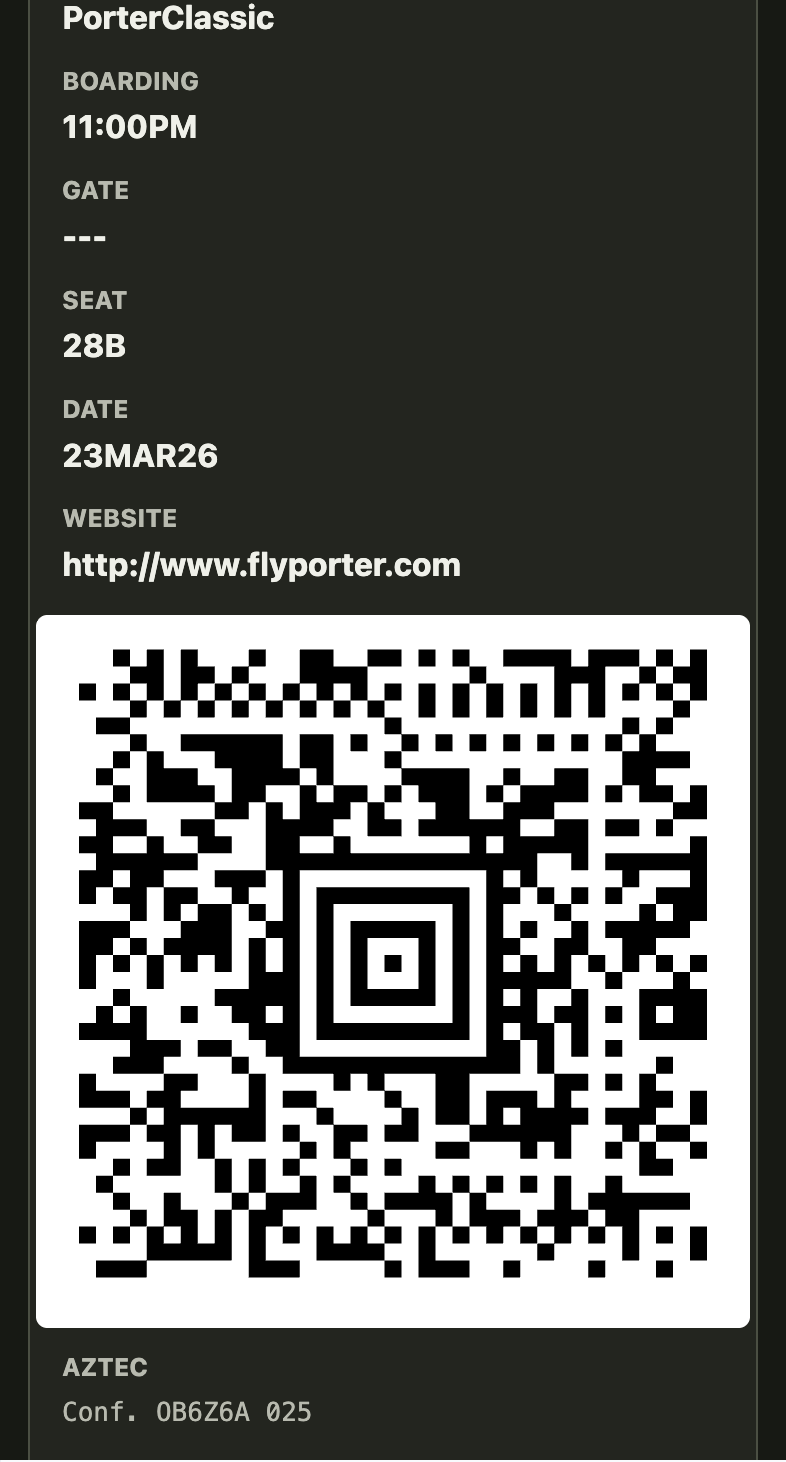
PKPASS packages can be shown as the passes people recognize: issuing organization, pass fields, artwork, serial information, and declared QR or Aztec barcodes. Safebox preserves the original signed ZIP package and does not rewrite or re-sign it.
W3C Verifiable Credentials
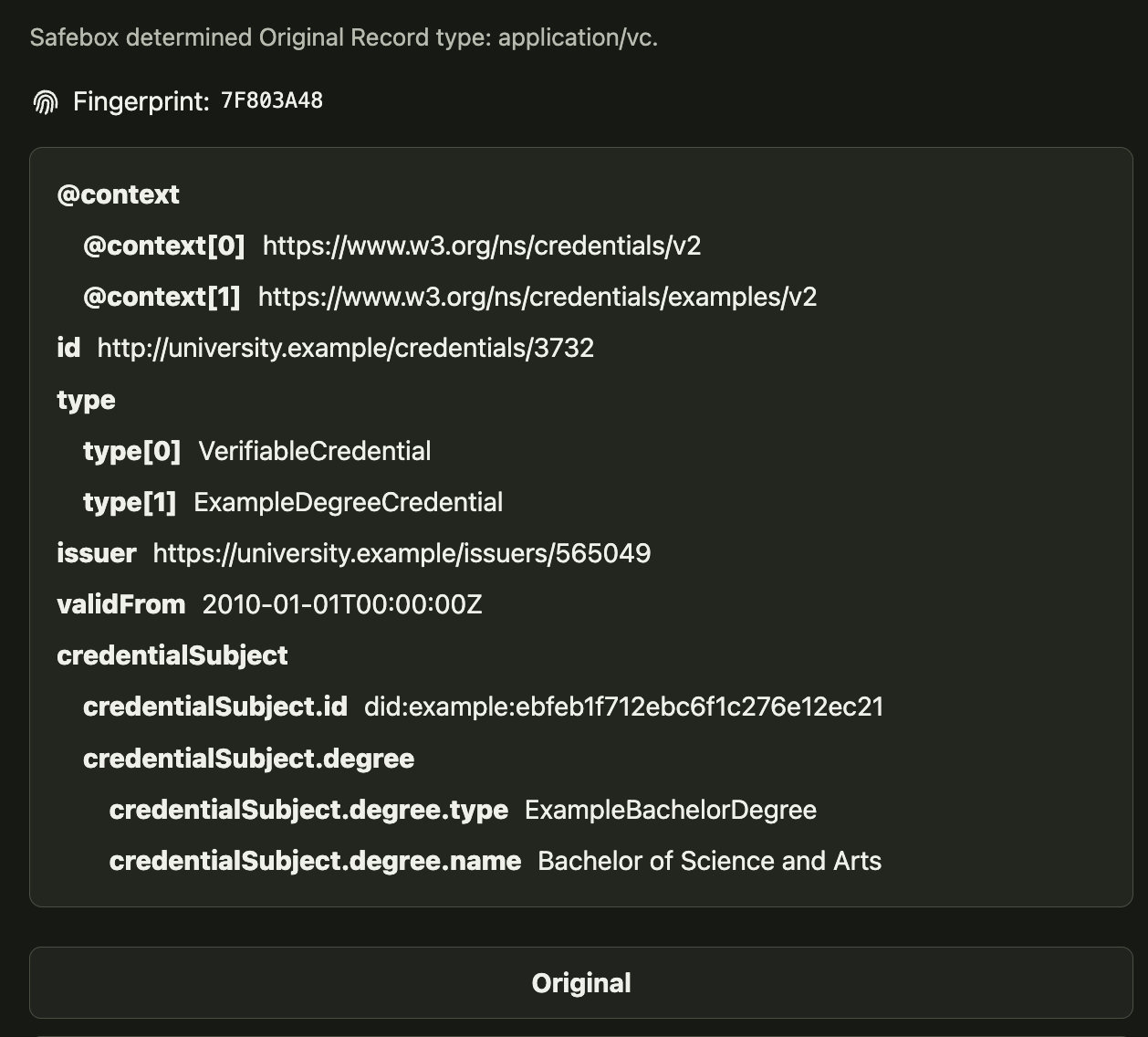
JSON W3C credentials and presentations can be recognized from their credential
context and type. Safebox renders nested key-value data so a person can inspect
the claims without downloading a .bin file or reading raw JSON.
EUDI PID
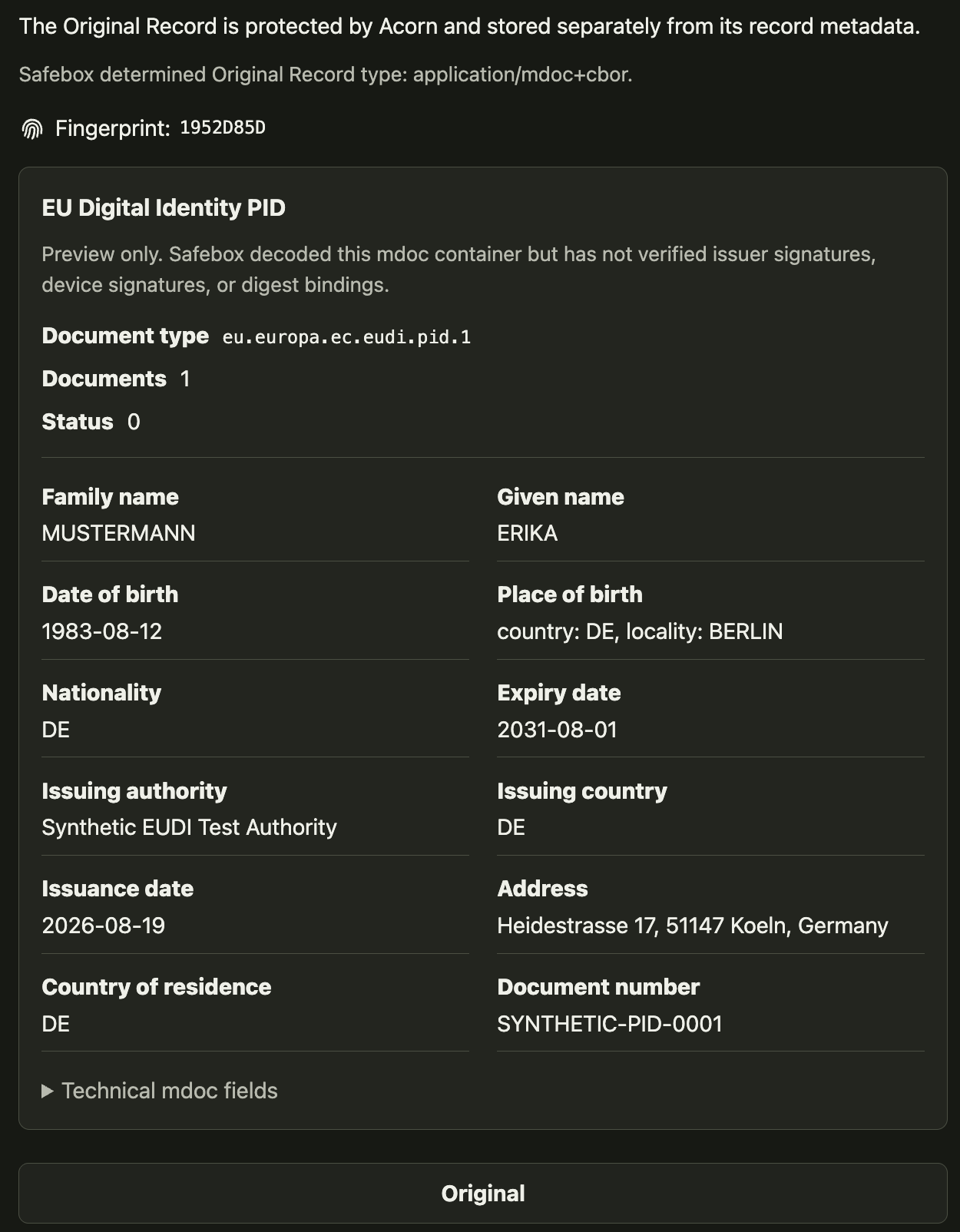
An ISO mdoc with document type eu.europa.ec.eudi.pid.1 receives a dedicated
PID view. Family name, given name, birth information, nationality, address,
document dates, and issuing details use human-readable labels. The underlying
technical CBOR structure remains available in a collapsed view.
Mobile driving licences
An ISO mdoc with document type org.iso.18013.5.1.mDL receives the same
semantic treatment. Identity, licence, age, issuing, and driving-privilege
fields can be presented cleanly while preserving the exact original mdoc.
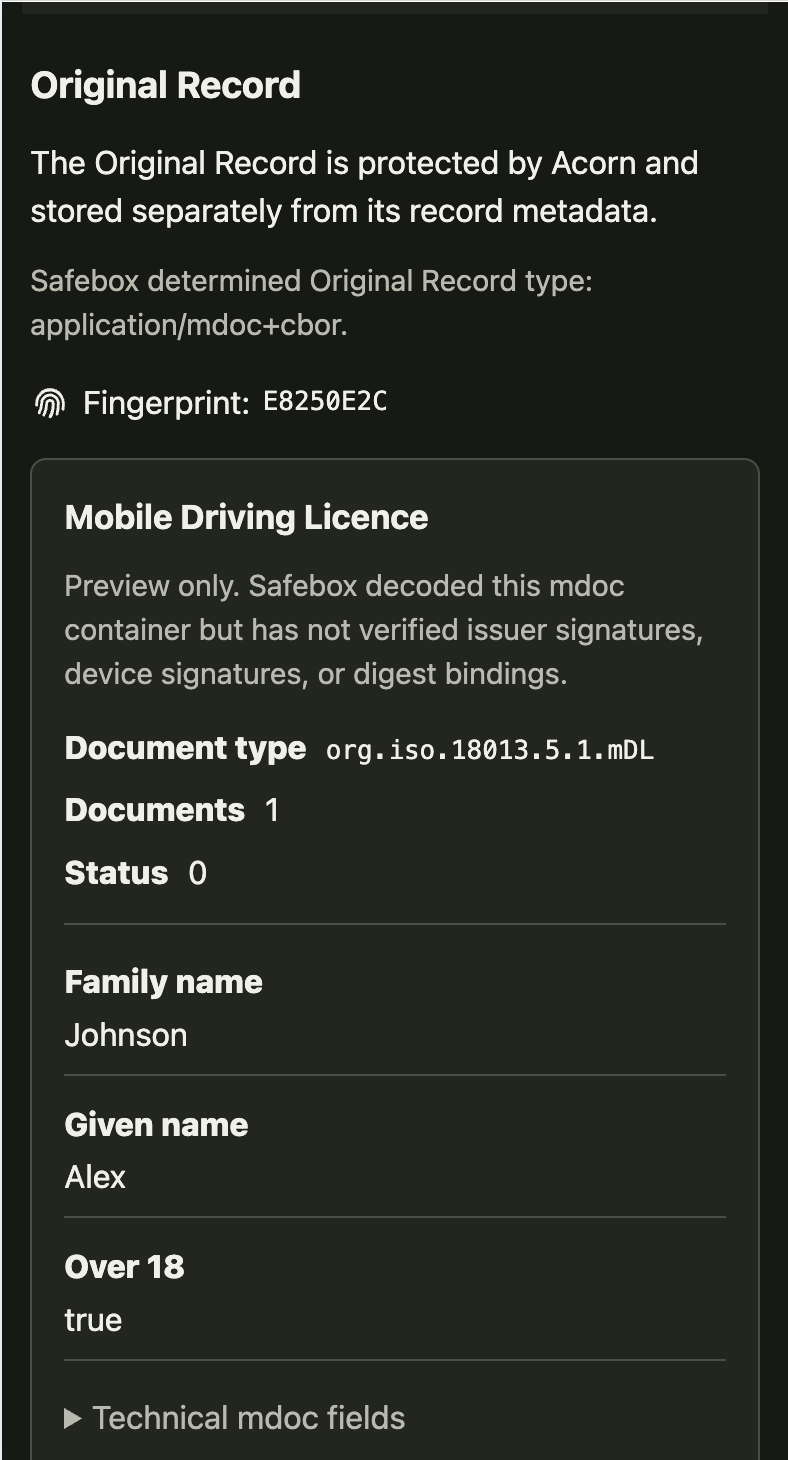
Both PID and mDL views are explicitly marked Preview only. Decoding a container is not verification of issuer signatures, device signatures, digest bindings, status, or trust policy.
Native verification stays native
Safebox does not flatten every standard into one pretend verification badge.
| Artifact | Native verification may include |
|---|---|
| PKPASS | Apple pass manifest, signature, certificate chain, and wallet trust behavior |
| W3C VC | Securing mechanism, issuer identity, credential status, holder proof, and verifier policy |
| EUDI PID or mDL | COSE signatures, MSO digest bindings, device authentication, trust lists, status, and presentation context |
| Embedded document signatures, certificate policy, timestamps, and revocation evidence |
Those mechanisms can be integrated through format-specific verifier adapters. The Uniform Digest Anchor remains useful before, during, and after native verification because it identifies the exact input evaluated.
Independent attestation and control
A separate protocol can bind signed statements to the same anchor without altering the Record File or claiming authority over its native scheme.
OpenETR is one example. It identifies an exact Digital Artifact, preserves signed evidence concerning actions such as transfer, encumbrance, redemption, or termination in a Digital Controllable Record, and derives consequential state under defined rules. Another community may care about inspection, archival custody, membership, local issuance, professional endorsement, or a different control lifecycle.
shared substrate: exact artifact + Uniform Digest Anchor

community A -> issuer trust and credential status
community B -> independent attestations and custody evidence
community C -> transferable control history
community D -> local recognition and acceptance policy
The substrate is common; authority and policy are not. Anyone may be able to make an attestation. A verifier still decides whether the signer is recognized, whether the statement is relevant and current, and what effect it should have. Transferring protocol control of a digest-bound record also does not automatically transfer legal ownership or modify the artifact's native holder relationship.
This separation lets Safebox support many record communities without becoming their universal schema owner, trust registry, or legal authority.
Understand Deep Verification Read the PKPASS implementation note