Wallets, cards and POS terminals across OakGate homes
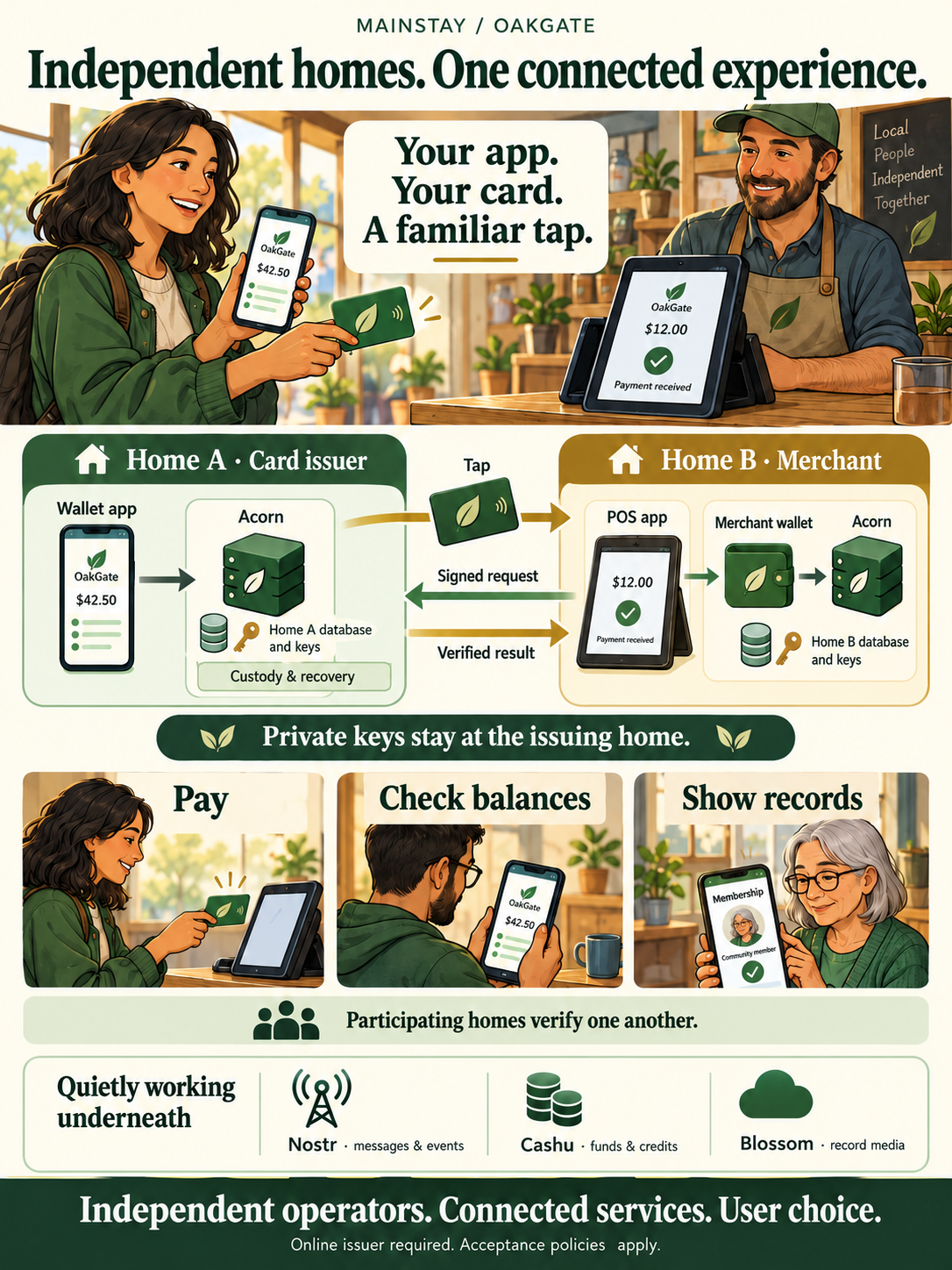
Read the illustrated user experience
OakGate supports both sides of a cross-home interaction:
- A local POS can read a foreign card. Its home forwards the requested operation to the card's issuing home.
- A local home can serve a foreign POS. It verifies a signed request from that POS's home and performs the permitted operation for its own card holder.
“Foreign” simply means issued or operated by another independent OakGate home. It does not mean unverified. Each home authenticates the other service, and the issuing home decides whether to accept the request.
The card is a reference to a wallet, not a wallet on plastic. The POS reads its credential; the issuing home resolves it to the holder's Acorn. Private keys and custody material remain at that issuing home throughout the interaction.
Example: a community member visits another merchant
Maya has an OakGate wallet at Home A and a card issued there. A merchant uses a POS activated with Home B. Maya does not need an account at Home B or a new card.
The merchant creates a payment request on its POS. Maya taps her card. Home B reads the issuer address and pinned service public key from the card, verifies Home A, and sends it a signed payment instruction. Home A validates the card and request, then uses Maya's Acorn to pay the merchant's invoice or Clear request. The POS follows its existing receipt polling to show detection or receipt.
The same arrangement supports a confirmed balance lookup or a request to show
an allowed record category. For example, a member record could be presented at
a participating venue that operates its own OakGate home. Multiple matching
records appear in the POS selector; one matching record retains the simple flow.
This does not mean every Community Credit is accepted everywhere. The selected mint, unit, available balance and existing payment policies still determine whether a particular payment can succeed.
The request path
Card issued by Home A
        |
        | NFC tap: issuer address, pinned service key, opaque credential
        v
POS activated with Home B
        |
        | Existing authenticated, device-signed terminal API
        v
Home B — acquiring home
        |
        | Signed operation over HTTPS
        v
Home A — issuing home
        |
        | Validate card and policy; use Acorn for wallet operations
        v
Signed result → Home B → POS
Home B never decrypts Home A's card credential. Home A never receives Home B's terminal session cookie or device private key. The browser does not gain a session in Home A, and the POS does not switch its configured API server for each card.
The homes can exchange roles on another transaction. Home A can acquire a card issued by Home B, provided Home B's policy permits Home A. Acceptance is directional: allowing B at A does not automatically configure A's acceptance at B.
Home-server boundary and client coordination
Cross-instance coordination occurs between the OakGate app servers, not between a wallet browser and a foreign POS server. Each client uses its own home's interface:
Wallet browser at Home A                         POS browser at Home B
          |                                               |
          | Local wallet requests and approval            | Local terminal requests and polling
          v                                               v
   OakGate App A <------ signed HTTPS ------> OakGate App B <---- POS Server B
   Wallet/custody home                        Merchant home      Own-home API proxy
The full logical path is:
Wallet browser → App A ↔ App B ← POS Server B ← POS browser
The POS server forwards terminal operations to its configured
OAKGATE_POS_API_URL at its own home. It does not change that destination to the
visitor's home. App B resolves the remote home and performs the authenticated
cross-home exchange with App A. For wallet QR approval, App A also fetches the
request from B and submits the user's approved presentation grant to B.
The POS browser polls its local API for request status and displays the returned result. The wallet browser fetches request details and explicitly submits approval to its own app server; it does not need to continuously poll or connect directly to the foreign home. The homes make signed API calls as the flow requires. A foreign domain in a QR code or card is routing information for those server-side exchanges, not permission to move the user's login session to that domain.
This boundary describes the cross-home coordination protocol. It does not mean all browser network traffic is confined to the home: sign-in redirects and other existing resource flows have their own paths. Opening a foreign QR URL in a native camera still opens that website; use the wallet scanner to retain the own-home approval flow.
User sessions, custody databases and Acorn private keys are not shared between homes. Record operations continue through Acorn, with Nostr relays and Blossom storage underneath. Payment operations retain their existing Acorn and mint contracts. The HTTPS coordination layer does not replace that architecture.
Transport roadmap: stabilize HTTPS, then evaluate NWC
Current implementation: FastAPI HTTPS APIs coordinate independent homes using signed, purpose-specific requests and responses. Client polling provides the POS experience. This is the first major cross-home iteration and should be stabilized through real two-home operation before changing the coordination transport.
Planned direction: use Nostr Wallet Connect (NWC) for cross-home coordination to reduce dependence on directly reachable REST endpoints between homes. The intended change is the App A ↔ App B link. Wallet and POS browsers would still use their own home interfaces, and each POS server would still use its configured home app. This does not propose eliminating HTTP from the entire deployment.
NWC coordination is not implemented or advertised as a supported transport. A separate protocol design must define which operations map to NWC and which require explicit extensions, particularly record requests, selected-record presentation, status and cancellation. We must not assume general NWC clients already understand OakGate's record operations.
Before introducing it:
- Verify the HTTPS baseline across independent deployments, including interrupted requests, expiry, cancellation, identity changes and recovery.
- Preserve stable service-key identity, explicit user or card authority, terminal binding, approved-record scope and directional acceptance policies.
- Specify authenticated and confidential request/result envelopes, correlation, replay handling, bounded lifetimes and relay delivery failure behavior through Stroma. User private-key operations must continue through Acorn.
- Preserve durable payment attempts and idempotency across transports. A timeout must never trigger a fresh payment over a different transport. Any fallback policy must be explicit and use the same operation identity and recovery state.
- Plan capability negotiation and mixed-version deployment so existing HTTPS homes keep working while NWC-capable homes are introduced.
The goal is to evolve the infrastructure transport while preserving the user experience, custody boundary and existing payment safeguards.
Identity, routing and authorization
The OGC2 card contains the issuer's HTTPS origin and pinned service npub, plus
an authenticated encrypted credential. The public key identifies the issuer;
the domain supplies its current contact address. They have different roles.
The acquiring home checks that the issuer's /info publishes the pinned key
before forwarding the credential. It verifies the signed response against that
same pin and binds the response to the exact request. A changed issuer key is
rejected. The current implementation also requires the encoded origin to match
the issuer's configured origin; automatic domain relocation or key rotation is
not implemented. Preserve the existing identity and routing or plan card reissuance.
The issuing home checks the acquiring home's HTTPS-published service identity, request signature, freshness and optional allowlist. It validates its own issuer pin, card activation, expiry, revocation and current wallet binding. It does not accept a claimed domain or arbitrary self-signed key as sufficient authentication.
A foreign POS is therefore accepted through its home, not independently registered as a terminal in the issuing home's database. The acquiring home verifies its terminal's authorization and signs the forwarded request. The issuer trusts that accepted home to represent the terminal. The terminal name is a claim made by that home, not independent proof of a merchant's legal identity.
No NIP-05 social npub is used to identify the card issuer or choose a wallet. Existing wallet discovery and Acorn payment rules remain in effect underneath.
Supported operations and limits
| Operation | Cross-home behavior |
|---|---|
| Pay by NFC | Issuer pays the merchant's exact stored Lightning invoice or Clear request through Acorn. No PIN prompt in the current POS policy. |
| Available Balance | Issuer returns Everyday Funds, a local-currency estimate when available, and Community Credits after the POS disclosure confirmation. |
| Check a Record | Issuer supplies an approved category's record choices and selected presentation, with attachment/PDF previews and OpenETR information. |
| Pay to a card from the wallet | Existing signed recipient resolution identifies the receiving Acorn; the payer reviews and confirms spending from their own wallet. |
| Issue a card | Remains home-local, including wallet approval and PIN disclosure. |
| QR wallet approval for a record request | Scan in the holder’s own OakGate wallet, approve selected records there, and present to the requesting POS across homes. |
| Card login | Remains with the issuing home's configured Keycloak flow. Federation grants no foreign account login. |
Record categories are whoami, myinfo, emergency, health, benefits,
member and pass. Matching is case-insensitive and includes the exact label
and slash-separated descendants. A maximum of 20 matches is allowed. Sessions
retain the original two-minute deadline; choosing another record does not extend it.
The issuer rechecks card authority before disclosure. Remote presentation receipts
are generated in the holder's wallet and identify the acquiring home and terminal.
Emergency-contact messaging also remains at the issuing home.
Independent homes, not a shared account system
Federation connects independent homes. It does not merge their users, receipt handles, databases, Keycloak realms or custody encryption keys. Each home maintains its own authority and recovery responsibilities. A visitor does not become a local user merely by tapping a card.
A satellite is different: it extends one home's presence and user population. A separate POS service connected to the same home is also not a foreign home. Cross-home card support is implemented; it should not be read as a claim that every planned satellite feature is implemented.
Trust and holder agency
The card holder can revoke the card through their issuing home. That home remains the authority for the card's wallet binding and permitted operations. Federation does not transfer custody or the Acorn recovery material to a merchant's home. The wider Go Independent commitment remains unchanged.
These inexpensive cards are copyable bearer credentials. Encryption protects the credential's contents, but not against copying the whole tag. Under the current no-PIN POS policy, a valid copy can authorize a payment or disclosure through an accepted home. Issuing a PIN does not protect an operation that does not check it. Service signatures establish which home submitted an instruction; they do not prove physical possession of the original tag or independent holder consent.
An empty OAKGATE_CARD_TRUSTED_INSTANCES permits verified signing homes. Setting
it to a list of service npubs limits which homes the issuer accepts for recipient
resolution and remote POS operations. This is an issuer-side access policy, not
a guarantee about a merchant's conduct. The receiving home can retain records or
balances it sees; clearing the POS display cannot erase another party's knowledge.
See the NFC trust discussion for loss and revocation.
Payments, interruptions and recovery
Both homes keep durable payment-attempt state. The acquiring home binds one receipt to one card and instruction before contacting the issuer. The issuer claims the attempt before preparation and records its outgoing payment ID before sending. Repeated or concurrent requests inspect the original attempt instead of initiating another send. Changing cards does not bypass the original receipt hold.
After an uncertain response, the acquiring home requests status. Missing status, a timeout or a crash is not proof of nonpayment and does not authorize an automatic resend. The existing SendService and Acorn transaction history remain the source for reconciliation. Do not pay the same request by QR and card simultaneously. A successful sending result is distinct from final receipt/redemption; the merchant's receipt polling continues to report the receiving side's progress.
The issuer is online for every operation. Federation does not add offline payments or an independent copy of the holder's wallet. An unreachable issuer results in an unavailable/uncertain operation, not a fallback to another identity or payment route.
Deployment checklist
- Deploy the updated app and pos services on both homes. No new database migration, card format or shared secret is required for this extension.
- Enable POS at both homes. Preserve each home's own service identity and NFC issuer data; do not copy service private keys between independent homes.
- Make each home's
/infoand/api/cards/v1/posreachable over public HTTPS. The transport rejects redirects, private DNS targets and nonstandard ports. - If using
OAKGATE_CARD_TRUSTED_INSTANCES, configure the permitted acquiring service npubs on each issuer. Configure both directions if both are wanted. - Keep clocks synchronized for signed-request freshness checks.
- Keep ordinary mint, relay, record-storage and Lightning connectivity working. Federation uses these existing services; it does not replace them.
No terminal reactivation or OGC2 card rewrite is required. Older OGC1 cards
lack the issuer pin and must be reissued. A home running an older release without
the endpoint cannot serve these operations; the acquiring home fails closed.
Acceptance checks before relying on a deployment
Use two independent homes with different service keys and a disposable test card. First issue at A and use B's POS; then reverse the roles if both directions are needed.
- Confirm balances and friendly Community Credit units without creating a user account at the acquiring home.
- Pay a small Lightning request and a compatible Clear request. Check both Acorn histories and the merchant's receiving status.
- Check one record, a category containing several records, and a PDF with OpenETR information. Confirm the holder's presentation receipt identifies the remote home.
- Repeat a request/status lookup and confirm there is no second debit. Exercise an interrupted response in a controlled test and reconcile the original attempt.
- Revoke the test card and verify subsequent operations fail. Check that an excluded acquiring service and a mismatched issuer pin are rejected.
- Close or replace a record request and verify stale results do not reappear.
Automated tests use independent stores and service identities with simulated transport, including duplicate requests and disconnect recovery. Physical NFC, public DNS/TLS, proxy configuration and live settlement still require deployment acceptance checks. The implementation is not a claim that every pair of deployed homes has already passed them.
For exact messages, endpoint limits and journal behavior, see the federated POS protocol.
Wallet QR presentations between homes
A wallet holder can now use Scan in their own OakGate wallet to scan a foreign POS record-request QR. A native camera opening that URL directly still opens the requesting home; it cannot discover which home the user belongs to. Use the wallet scanner for the cross-home approval flow.
- Home A retrieves signed request terms from POS home B: terminal name, category and the original two-minute deadline. The wallet shows B's domain alongside the terminal name; the name is B's claim, not independent merchant verification.
- The authenticated user chooses records at A. A single matching record keeps the simple approval button; multiple matches require explicit checkbox selection.
- A issues a short-lived grant bound to B's public identity, domain and request. B atomically accepts one presenter across both QR and NFC flows. Duplicate delivery of the same grant is idempotent; another grant cannot replace it.
- B requests only a selected approved record. A creates and inspects its presentation through Acorn and returns a signed result for the existing POS renderer, including supported attachments and OpenETR information.
- Close Request removes B's access and attempts to revoke A's grant. Expiry remains the original deadline even if the other home is unreachable. A new request makes the previous request inaccessible through the POS.
The holder's home publishes the existing best-effort presentation receipt with remote terminal attribution, and handles emergency contact notices. These are access receipts, not proof of reading or a complete audit trail.
The fixed endpoint is POST /api/records/v1/presentation, advertised as
wallet-record-federation-v1 in /info. Stroma signs purpose-separated messages;
responses bind to the exact request digest. HTTPS discovery pins the peer identity
for this interaction. Later changes to that identity fail verification. The existing
OAKGATE_CARD_TRUSTED_INSTANCES acceptance list applies to these exchanges too.
Public-only HTTPS transport, no redirects, bounded bodies, peer rate limits,
CSRF-protected approval and encrypted expiring state are reused. No user private
key leaves Acorn and no new payment authority is granted.
Rebuild the app on both homes. The existing POS display API is unchanged; no terminal re-pairing, new environment variable or database migration is needed. Both homes need their existing service identity, POS enabled, and reachable public HTTPS endpoints. Old homes fail closed; there is no social NIP-05 fallback.
Automated two-home checks cover selected-record disclosure, single-record approval, replays, cancellation, replacement, ownership and identity binding. Before rollout, test two real homes: scan in A's wallet, approve one or several records, display at B, check PDF/OpenETR and Receipts, then close/replace/expire the request. Also verify that the other wallet cannot approve A's local ticket. Live cross-home acceptance remains an operator deployment check.
Sharing a record to a foreign card
A wallet can also scan a paired card from another home and confirm delivery of a record to that card's Acorn. This is separate from POS record presentation: the recipient retains a copy. See Share records to NFC cards for issuer verification, storage permissions and one-attempt recovery semantics.