Meet Project OakGate
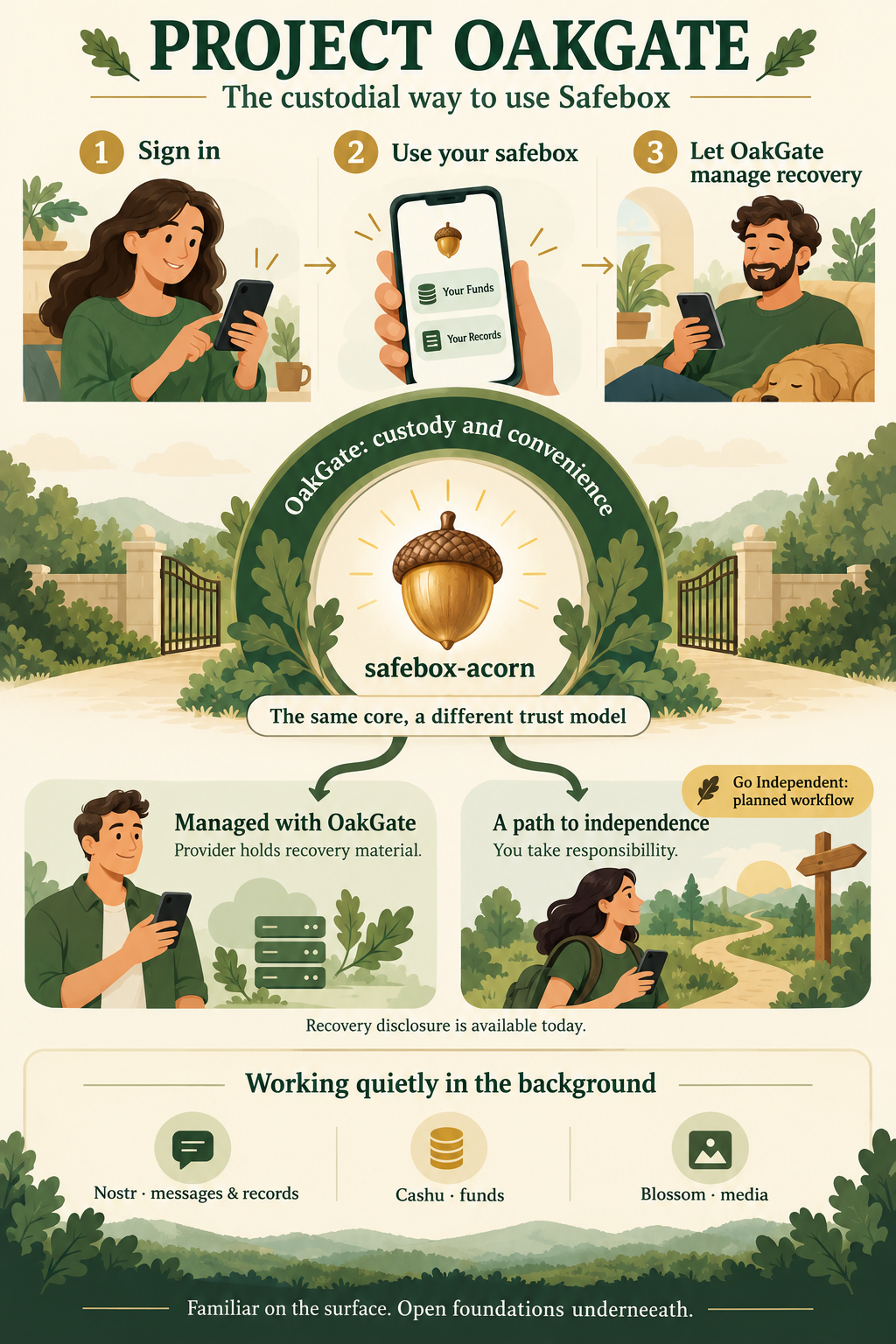
Open the full-size infographic
The illustration explains the product direction. Screens are illustrative; the complete Go Independent workflow is planned.
Leah wants somewhere to receive a payment, hold community credits, and keep a record someone has shared with her. She is comfortable signing into a website. Managing a private key and choosing a relay would be unfamiliar first steps.
Project OakGate is the custodial version of Safebox. It gives Leah a familiar way to use a safebox, with a provider taking responsibility for holding her recovery material and operating her wallet on her behalf. Underneath that experience is safebox-acorn, the same core component used by Safebox Web.
Leah is an illustrative user. Her story introduces the experience and the choice of responsibility behind it.
Start with something familiar
Leah opens OakGate and signs in using one of the options offered by her provider, such as Google or an email-and-password account. She can create a new Acorn or connect an existing one using its recovery information.
Once connected, the everyday interface is straightforward: Funds, Records
and Receipts. She has a receipt address that looks like an email address.
She can show a payment request, receive Everyday Funds or Community Credits, and open a shared record.
At an OakGate terminal, she can also present her whoami or myinfo record:
she approves a QR request in her wallet or taps a card from a participating OakGate home. Staff use
Show Record to view it temporarily, including a supported image attachment
and OpenETR information. See the record presentation flow.
She does not need to understand the protocols before using these features.
OakGate's custody also allows it to receive and settle supported payments while Leah is away. She does not have to keep her browser open for every incoming payment to be processed.
A provider takes responsibility
When Leah forgets her sign-in password, the configured identity provider offers its account-recovery process. Keycloak connects those sign-in options to OakGate; Google is one possible provider, not the identity of her underlying Acorn.
OakGate separately retains encrypted wallet secrets and recovery information. Account recovery helps Leah regain access to the service. Acorn recovery material serves a different purpose: recovering the underlying safebox.
This convenience involves trust. The operator can use her wallet on her behalf and must protect its secrets, maintain backups, and keep the service available. Encryption at rest does not make OakGate non-custodial. Leah chooses a provider she is willing to trust with those responsibilities.
The same Acorn underneath
OakGate adds a custodial layer around safebox-acorn. Acorn still performs the wallet operations, including operations that use the user's private key. OakGate coordinates access and background work without inventing a different wallet architecture.
Safebox Web uses that shared foundation with a different boundary: it does not persist the user's private key server-side, and uses it during an authenticated session. OakGate intentionally retains the material needed to operate the wallet for the user. The distinction is who takes responsibility for custody.
The supporting infrastructure stays mostly out of Leah's way:
- Nostr relays carry wallet messages and record events.
- Cashu supports the token operations behind Cash and Clear funds. Lightning provides a payment route for Cash when an invoice is used.
- Blossom supports record attachments and media.
These components can be operated by communities and service providers. They are shared foundations for the experience, rather than concepts Leah must learn to complete her first payment.
Independence remains part of the design
Later, Leah may want to take responsibility for her own safebox. The intention is that choosing convenience today should preserve a practical path to independence through Acorn.
Today, OakGate can disclose her recovery phrase, bootstrap relay and recovery mode after fresh authentication. Those details belong together and must be kept private. Viewing them does not end custody or remove OakGate's access.
Go Independent is the planned next step: help Leah verify independent recovery, safely finish outstanding activity, and then end custody and remove OakGate's retained information and delegated access. The complete workflow is not available yet. Recovery also depends on the relevant relay, mint and media state being available; a phrase alone is not a promise that every asset or attachment can be restored.
Even after a future departure, a provider cannot prove that no historical copy of a secret remains. The process must explain retention and deletion limits honestly.
For Leah, the promise guiding Project OakGate is simple: a welcoming place to start, with the same Acorn foundation supporting a path to taking responsibility herself.
Try the card experience · Explore a merchant's terminals · Custody models · Recovery disclosure today · Go Independent design
Terminology: Everyday Funds means Cash; Community Credits means Clear balances. Some illustrations and payment controls retain Cash/Clear. See user-facing language.
Across participating homes
The wallet and terminal can belong to independent OakGate homes. The terminal stays with its own home, which verifies and contacts the card issuer for the requested operation. The holder does not need a second account at the merchant's home. Acceptance policies, compatible credit assets and online connectivity still apply; card issuance remains home-local; record QR approval also works between participating homes. See Independent homes, one connected experience.