A day at the beach without a phone
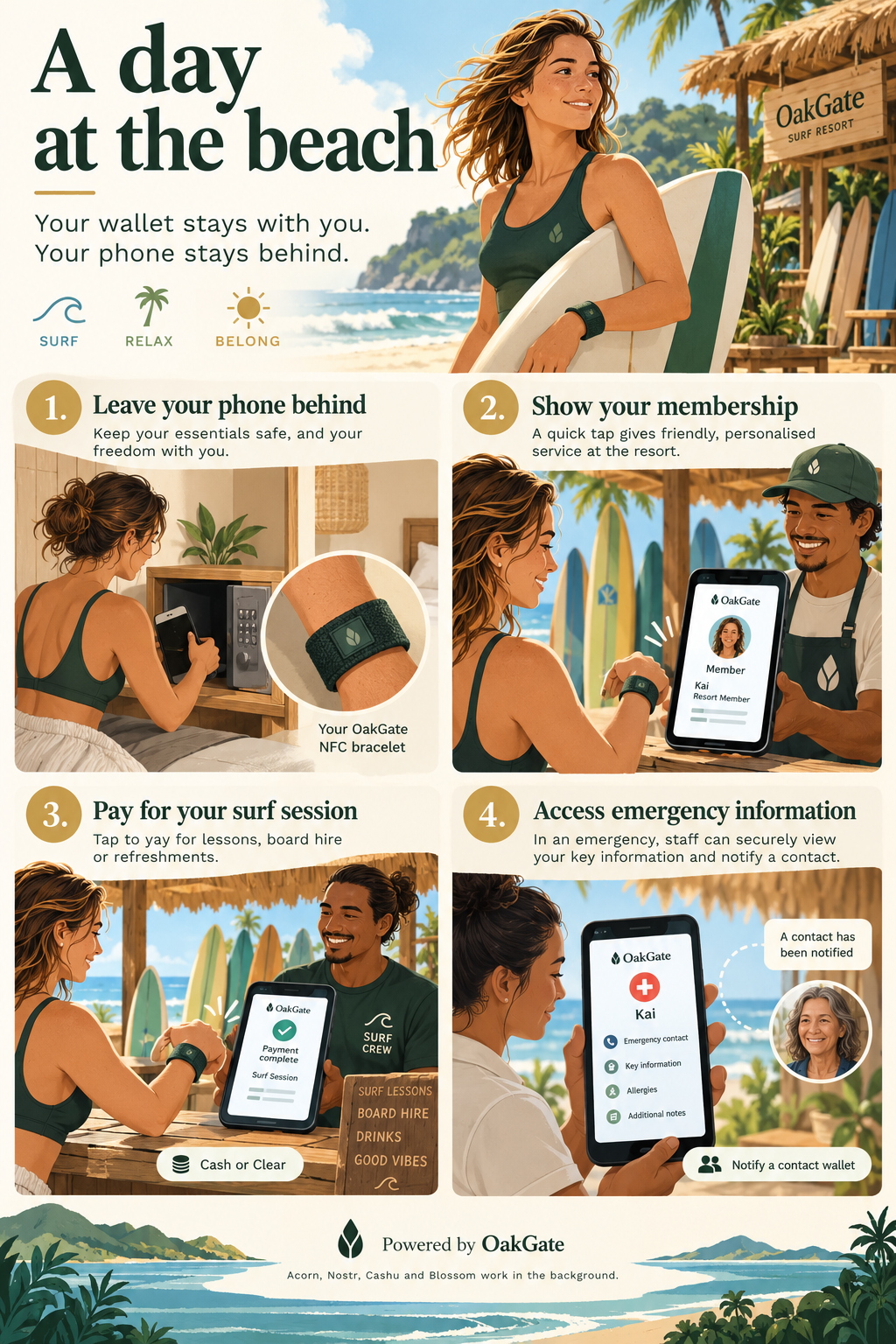
Open the full-size infographic
An illustrative resort story and bracelet concept, not product screenshots or a waterproof hardware specification. “Notified” in the illustration means a message published to a wallet relay; it does not confirm that the contact has read it.
Ready before leaving the room
Kai is heading to the beach for a surfing expedition. Her phone stays in the room. Earlier, she paired her OakGate wallet with the resort's terminal and approved an NFC credential written into a neoprene bracelet. The bracelet works like her card: it gives the terminal a way to reach her wallet, without storing her wallet's private key or her records on the bracelet.
Her wallet has Everyday Funds for purchases and the resort's supported Community Credits. She has also prepared a whoami record with her photo and resort membership, and an emergency record containing information she chooses to make available.
A tap to show membership
At the surf desk, the attendant opens Check a Record, selects whoami and creates a request. Kai taps her bracelet. The attendant selects Show Record and sees the membership record and its original image. Where an attached artifact has OpenETR information, the terminal shows that verification information too. The resort decides whether the evidence satisfies its membership policy.
The record remains in Kai's Acorn. The terminal displays a temporary presentation; it does not import the record into the resort's wallet. A new request or Close Request removes the display, and the request expires after two minutes.
A second tap to pay
The attendant switches to Point of Sale, enters the amount and selects Cash for Everyday Funds or the appropriate Community Credits asset using its friendly name. Kai taps to pay for the surf session. The terminal follows the payment through its existing receipt flow; a detected payment and a finalized credit are different states. Her phone is still in the room.
Emergency information when it is needed
If Kai needs help, staff can request emergency and read her bracelet with the same terminal. Her record includes a separate line such as:
contact:alex@wallet.example
When the terminal acquires the emergency presentation, OakGate attempts to send Alex an inter-wallet message from Kai's Acorn saying that her emergency record was accessed, with the time and a request reference. The message does not contain her medical information or an attachment. It is an access notice, not a diagnosis or confirmation that an emergency occurred. No email is sent.
The contact address can also be a NIP-05 social address, but it must support Safebox
wallet discovery: delivery resolves the Acorn key and relays through safebox.json,
not the social public key. A NIP-05-only address is not sufficient.
The terminal reports whether publication was confirmed. A contact may be offline or may not read the message. Staff must use their normal emergency procedures; this notification is not an emergency dispatch service.
A small object, a connected wallet
Kai experiences a bracelet, a tap and a clear screen. Acorn handles wallet and record operations; Nostr relays carry wallet messages, Cashu supports funds and Blossom supplies record attachments quietly in the background. The staff terminal and services need connectivity; the bracelet does not run an offline wallet.
The current flow uses activated local or accepted remote cards and compatible Android NFC browsers. Record access does not ask for a PIN, including emergency access. Anyone possessing the bracelet may be able to present these designated records at an authorized terminal, so Kai chooses carefully what she puts there. She can revoke the credential from her wallet if it is lost. Neoprene is a form-factor concept: the chosen tag and enclosure must be tested for the intended water exposure.
See POS record requests for setup, notification limits and the supported record labels.
Terminology: Everyday Funds means Cash; Community Credits means Clear balances. Some illustrations and payment controls retain Cash/Clear. See user-facing language.
Across participating homes
The wallet and terminal can belong to independent OakGate homes. The terminal stays with its own home, which verifies and contacts the card issuer for the requested operation. The holder does not need a second account at the merchant's home. Acceptance policies, compatible credit assets and online connectivity still apply; card issuance remains home-local; record QR approval also works between participating homes. See Independent homes, one connected experience.